
Explore the Legacy and Passion Driving Wooden Nickel Speed Shop
Wooden Nickel Speed Shop is devoted to celebrating and preserving the rich heritage of speed culture from the 1930s to the 1970s. Our mission is to inspire enthusiasts through authentic craftsmanship, educational resources, and community engagement, fostering a deep appreciation for vintage hot rods, motorcycles, and custom creations.
The Name
There’s a boat club on the East Coast, established in the 1950s, where wooden nickels moved around the room all night.
They weren’t money. If you bought somebody a beer, they were likely to get a wooden nickel back — not as payment, the beer was already paid for, but as the thanks. It meant somebody noticed. It meant the next round was already spoken for. You’d put it in your pocket and it would turn up weeks later and remind you who you’d been drinking with.
That’s where the shop’s name comes from. Not the old warning about taking wooden nickels — that phrase is older than the tokens and has nothing to do with them. It was a caution about counterfeit coins back in the 1920s.
The real wooden nickel has a better story.
Where They Actually Came From
In 1931, banks started failing. In Tenino, Washington, the Citizens Bank went under and took the town’s deposits with it. So the Chamber of Commerce and the local newspaper printed money on wood worth a quarter of what people had lost, spendable at any shop in town. Blaine, Washington did the same thing and struck a five-cent piece. It worked. The town kept trading.
By the 1933 Chicago World’s Fair, wooden nickels were souvenirs. After that they became what they were at the boat club: a token you handed somebody because you meant something by it.
That arc is the whole reason the name fits. People with a problem and no money made what they needed out of what was in front of them, and it held the community together while they did it.
That is also the exact thing that happened on the dry lakes. Kids with Model A’s and surplus parts and no budget built cars that went faster than anything Detroit was selling, and they did it in each other’s garages. Same instinct. Same decade.
Where the Shop Comes From
My father kept his business office on the second floor of an automobile repair and tow shop in South Amboy, New Jersey. He and the owner had been friends a long time.
So I got there in the mornings with him, and then I was downstairs. I spent the day crowding the mechanics — standing too close, asking too much — until one of them handed me a job fetching tools, mostly to get me out from underfoot. On a good day I got brought along in the tow truck.
Nobody sat me down and taught me anything. You pick it up standing next to it.
The cars and the bikes and the boats came with that. The speed shop is what happens when it doesn’t go away.
What We Make
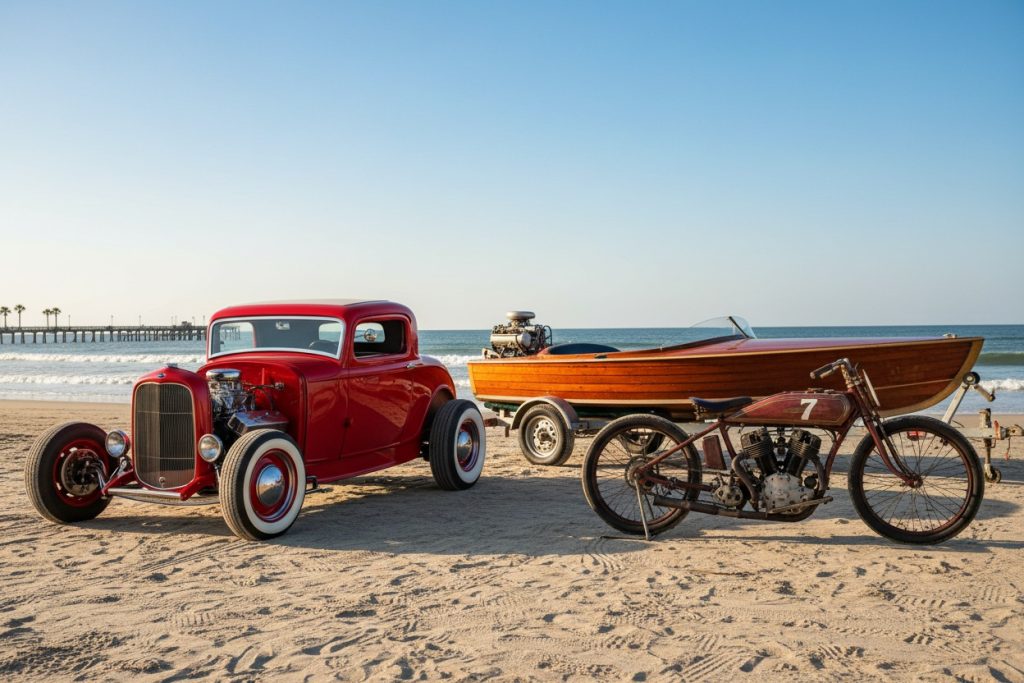
Wooden Nickel builds parts for the machines people were making fast between the 1930s and the 1970s — traditional hot rods, bobbers and choppers, and wooden speedboats.
Every part carries an honest label:
- Reproduction — a copy of an original part, measured from the real thing
- Tribute — period-styled, but a modern design
- Original — a new design in the period idiom
We don’t blur those three. A tribute part never gets sold as a reproduction. When we make a historical claim about a part, we say where it came from and how confident we are — documented, widely believed, or our best guess. The people buying these parts know the difference, and the ones who don’t deserve to be told.
Recognition
First place, Sportster class — 21st Annual David Mann Chopperfest, Ventura, California, February 2025.
The bike is a 1973 Ironhead XLH, kickstart only, bought as a rough project — no paint, barely assembled. The motor was torn down completely and reassembled with a new flywheel. The paint and bodywork were done here. Chopperfest is judged by people who build these for a living, which is the only reason it’s worth mentioning.
The Nickels
Every order ships with a wooden nickel.
It’s the same idea as the boat club — a thank-you you can put in your pocket.
Our business cards are wooden nickels too, with a QR code on the back. If somebody hands you one at a swap meet, that’s how you found us.
Who’s Behind It
Wooden Nickel Speed Shop is a solely owned and operated in the Antelope Valley, California.
The engine work, the fabrication, the paint and the bodywork all happen in this shop. Not because doing everything in-house is a virtue by itself, but because it’s the only way the work comes out the way we want it.